Stories › Kids › The Sandpiper and the Sea
Kids · 4 minThe Sandpiper and the Sea
Once upon a time, on the shore of the great southern sea, there lived a pair of sandpipers. They were small grey birds with thin legs, and they ran up and down the wet sand all day, picking at whatever the waves had left behind. The husband was called Tittibha, and he had a very high opinion of himself. His wife was the sensible one.
When the time came for her to lay her eggs, she looked along the beach and shook her head. "The tide comes too high here," she said. "Let us go further up, among the rocks."
"Nonsense," said Tittibha. "I am here. Who would dare? The sea himself would not touch the eggs of Tittibha."
"Husband, the sea is a little bigger than you."
"That," said Tittibha, "is only size."
So she laid three speckled eggs in a small hollow in the sand. But the sea hears everything that is said on his beaches, and he had heard this. He was more amused than angry. "Let us see what this great bird will do," he said. That night one long, quiet wave came higher up the sand than any wave had come before. It lifted the three eggs as gently as a mother lifts a sleeping child, and it carried them away.
In the morning the hollow was empty. The wife sat beside it and cried. She did not say, "I told you so," and that was much worse than if she had. Tittibha stood very still for a long time, and for once he had nothing to say. Then he walked down to the edge of the water.
"I promised that they would be safe," he said in a small voice, "so I shall get them back. I will empty the sea."
He took one beakful of water, flew up to the dunes and spat it out on the sand. Then he flew back and took another.
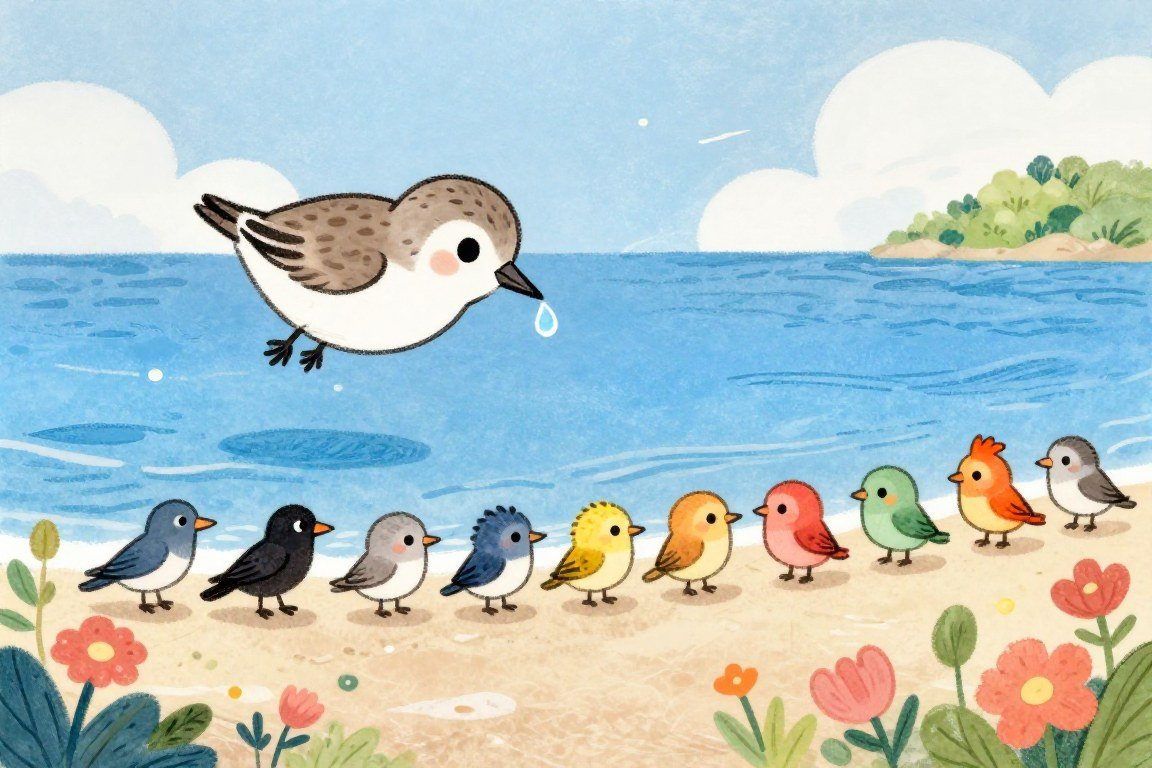
By noon the other birds had come to watch. "What are you doing?" asked an old heron. "Emptying the sea," said Tittibha, with his beak full. The heron laughed until he had to stand on both legs. "It will take you ten thousand years!" "Then I had better not stop for lunch," said Tittibha, and he flew off again.
Nobody laughed after that. His wife got up from the empty hollow, walked down to the water without a word, and took a beakful too. Then came a plover who had once lost her own eggs to the tide. Then came the sparrows, because they did not want to be left out, and the crows, because they wanted to know what was happening. By the third day a thousand birds were flying back and forth, and the sea had not gone down by the width of one feather.
But the news had gone a long way. It reached Garuda, the great golden eagle, who is the king of all the birds and who carries Lord Vishnu on his back. He came down out of the sky and landed on a rock, and every bird on the beach went quiet.
"Is this true?" he asked. Tittibha stood in front of him, with salt on his beak and his feathers all out of order. "It is true, my king. I am very small, and I may not finish. But they are my children." Garuda did not laugh. He looked at the little bird for a while, and then he flew straight up to Lord Vishnu and told him the whole story.
So it happened that Lord Vishnu himself came to that small beach, and he spoke to the sea in a quiet voice. "Those eggs are not yours." The sea had carried his joke too far, and he knew it. He drew back from the shore, and then one long, slow wave came rolling up the sand. It set three speckled eggs down on the dry ground, warm and whole, without a single crack.
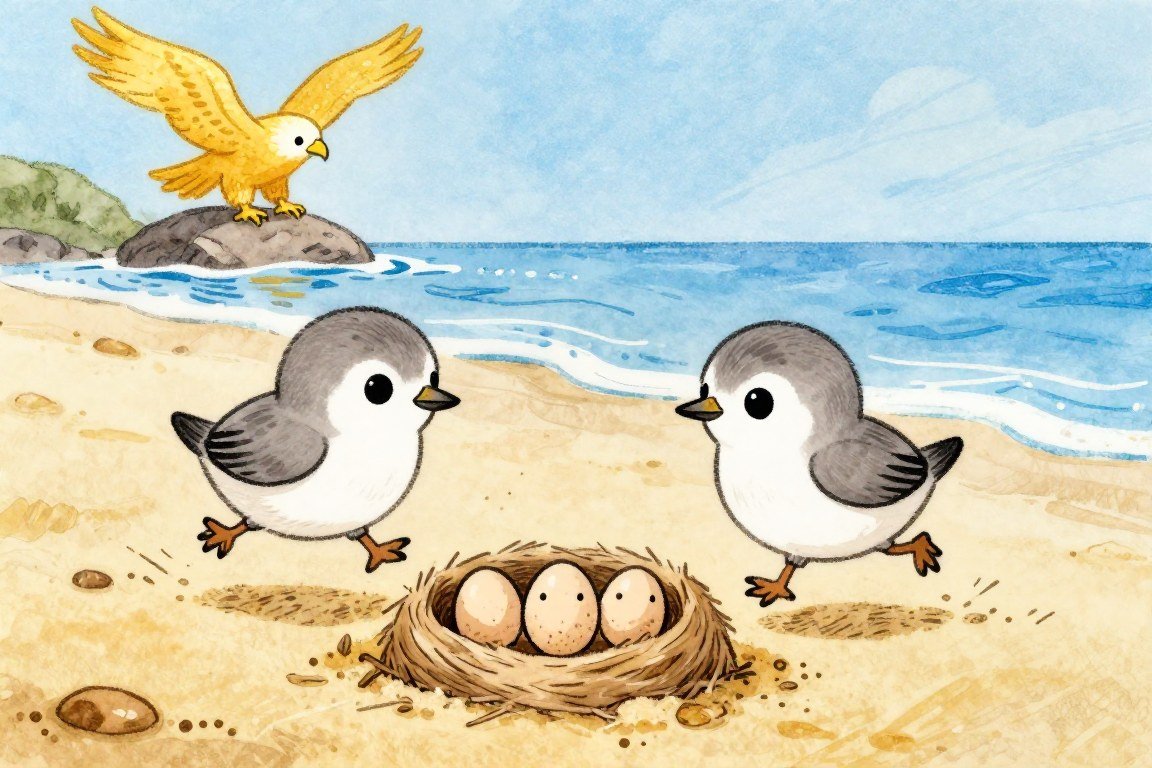
A thousand birds shouted at once. The wife ran up the beach and sat down on her eggs, and she would not move for anybody. Tittibha shook out his feathers. "You see?" he said to her. "I told you that the sea would not dare." She looked at him for a long moment. He coughed. "Next year," he said, "I think we might nest among the rocks."
And so the old birds of that shore still tell their young: "Do not boast to the sea, and do not laugh at a small one who will not give up. When you have lost something dear to you, begin with one beakful. Others will come."
❦