Stories › Kids › The Talking Cave
Kids · 4 minThe Talking Cave
Once upon a time, on a rocky hill at the edge of a great forest, there lived a jackal called Dadhipuchha. He was not big and he was not strong, but he had a very good nose and an even better habit: he always looked before he walked.
His home was a cave in the side of the hill. It was cool in summer and dry in the rains, and its door was round, like an open mouth. Every evening Dadhipuchha came trotting home up the stony path, and every evening he said the same thing at the door: "Good evening, cave!" The cave, of course, said nothing. But Dadhipuchha liked saying it all the same.
One day a lion called Kharanakhara came over the hill. He had been hunting since morning and had caught nothing at all. The deer had run, the wild pigs had hidden, and even the rabbits had laughed at him from their holes. By evening he was tired, his paws hurt, and his stomach was growling louder than he could.
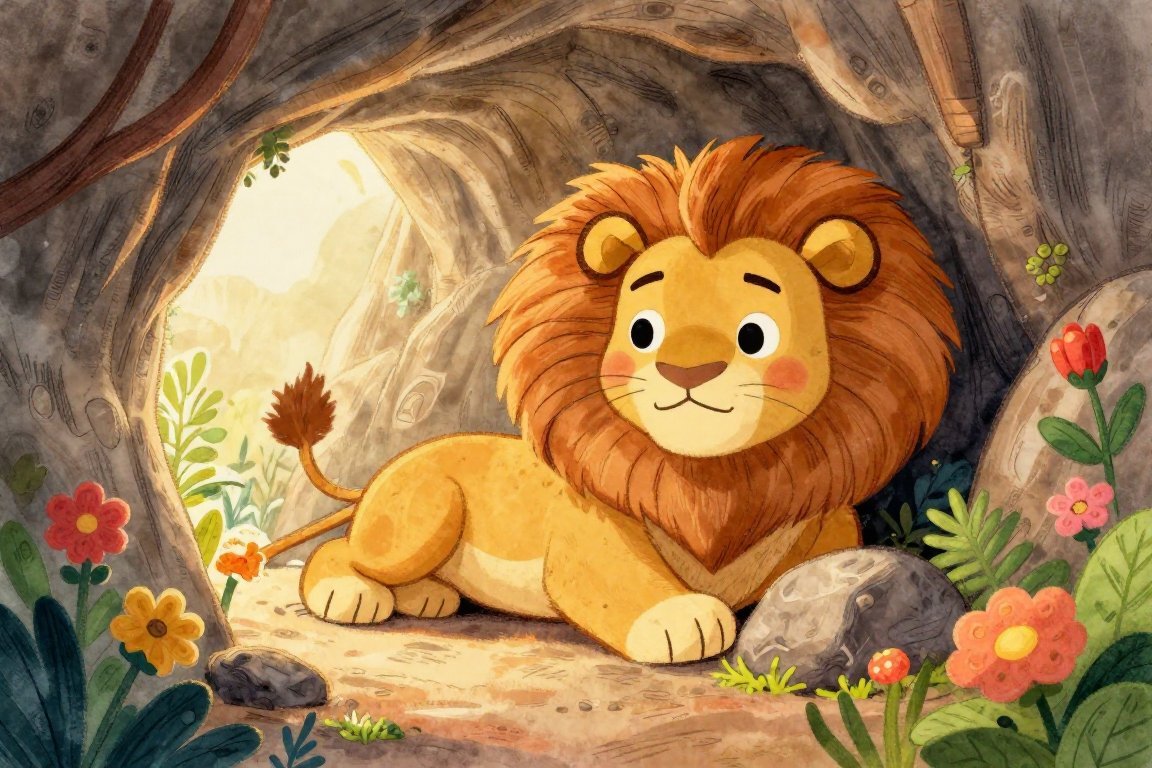
Then he saw the cave. He sniffed at the doorway. "Somebody lives here," he said, "and whoever it is will come home tonight." A slow, pleased smile spread across his big face. "Why should I run after my dinner? I shall sit inside and let my dinner walk in to me."
So he went into the cave, lay down behind a rock in the darkest corner, and waited, as quiet as a lion can be.
Soon the sun went down, and Dadhipuchha came up the path, humming a little song. At the door of the cave he stopped, and the song stopped too. In the soft dust in front of the cave there were footprints: large, round footprints with four big toes. They were the footprints of a lion. Every one of them pointed into the cave, and not a single one pointed out.
Dadhipuchha's tail went stiff. "A lion went in," he said to himself. "A lion did not come out. So a lion is still inside." He wanted to run. Then he thought, "Perhaps it went out some other way. Perhaps the wind made those marks. I do not want to lose a good home for nothing. Let me find out."
So he stood well back from the door, where he could turn and run in a moment, and he called out loudly, "Hello, cave! Hello-o, cave!" Nothing answered. He waited a little and called again, louder. "Cave! Have you forgotten our promise? Every evening when I come home, I call you, and every evening you answer me. If you do not answer today, I shall know that something is wrong, and I shall go and sleep somewhere else!"
Inside, Kharanakhara began to worry. "So this cave answers him every evening," he thought. "It must be too afraid of me to speak tonight. If it stays quiet, my dinner will go away. I had better answer for it." He took a deep breath, put his mouth close to the wall, and called out in his kindest voice, "Come in, my friend! Come in!"
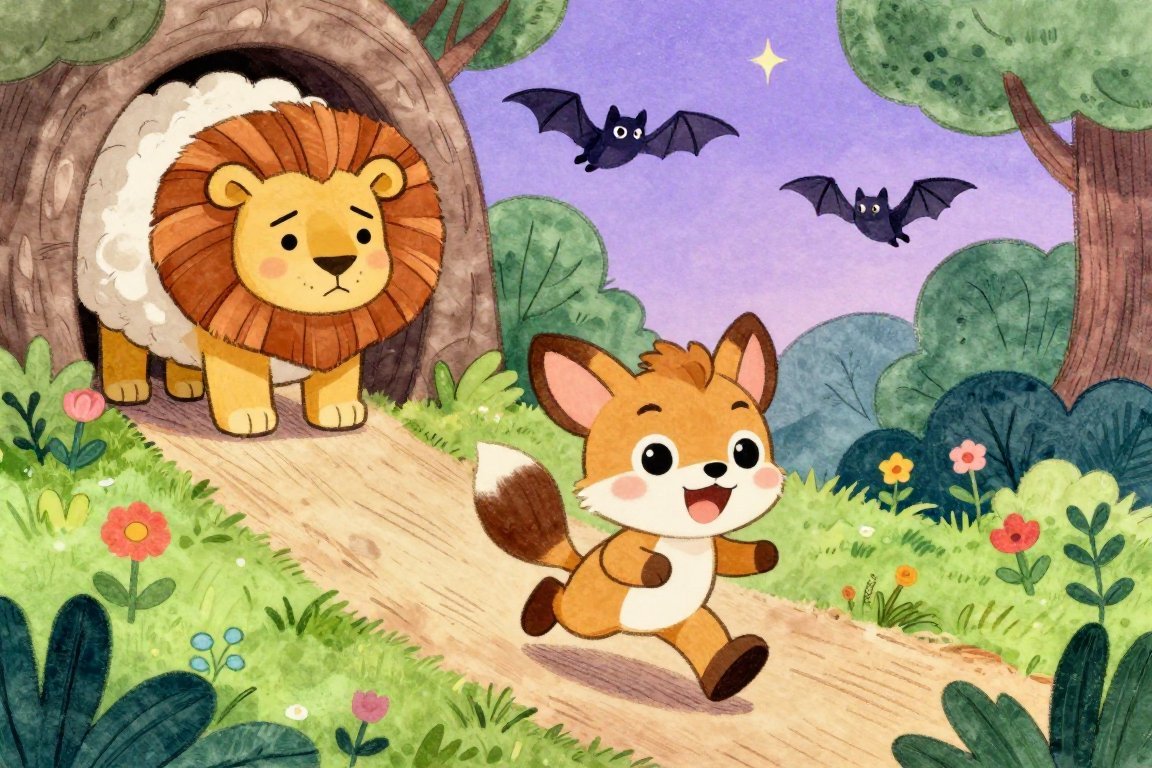
But a lion's kindest voice is still a lion's voice. It went rolling round the cave, booming and growling, and came out of the round door like thunder. The stones shook, and two bats fell off the roof.
Dadhipuchha did not wait to hear any more. "Caves don't talk!" he shouted over his shoulder. "But lions do!" And he was down the hill and away into the forest before the echo had finished.
Kharanakhara came out of the cave and looked down the empty path. Then he looked at the footprints. They were his own footprints, all pointing into the cave and telling everybody exactly where he was. "Well," he said at last, "I have been beaten by a jackal and a lump of rock." He went back over the hill, hungry but a little wiser, and he never again tried to hide in anybody's house.
As for Dadhipuchha, he found a new cave on the far side of the forest, with a smaller door. Every evening he still says, "Good evening, cave!" And every evening, before he says it, he looks at the ground.
And so the elders say: before you walk into any place, look at the signs in front of it. A quick mind that stops to think is a better guard than sharp teeth.
❦