Stories › Kids › The Singing Donkey
Kids · 4 minThe Singing Donkey
Once upon a time, in a small village, there lived a washerman who had a donkey called Uddhata. All day Uddhata carried bundles of wet clothes to the river and bundles of dry clothes back. The washerman could not afford to feed him very much, so at night he took off the rope and let the donkey go and find his own dinner.
On one of these nights Uddhata made friends with a jackal, who was also looking for dinner. The two of them got on very well. It was the jackal who found the gap in the hedge, and on the other side of that hedge was a field of the sweetest cucumbers in the whole district. Every night they slipped in without a sound and ate until they could eat no more, and every morning they were gone before the first crow. The farmer could not understand it.
One night the moon was very full and very bright, and the air was cool. Uddhata had eaten eleven cucumbers. He lifted his head and sighed with great happiness.
"Nephew," he said to the jackal, "look at that moon. What a night this is. I feel a song coming on."
The jackal stopped chewing. "Uncle," he said carefully, "we are two thieves in another man's field. Thieves do not sing."
"You say that because you know nothing about music. You only howl. Do you know that there are seven notes? Do you know that there are three scales, and that a true singer must feel the mood of the hour? I have been studying for years, on the road to the river."
"Uncle, the watchmen are asleep in that hut, just over there. And your voice, if I may say this politely, carries."
"You mean that it is too good for you," said Uddhata, and he stood up very straight. "Very well. A jealous audience is the burden of every artist."
The jackal looked at the hut, and he looked at the donkey, and he saw that there was nothing more to say. "Uncle," he said, "you sing as you please. Let me go and wait by the hedge. Somebody should keep watch." And he went, rather quickly.
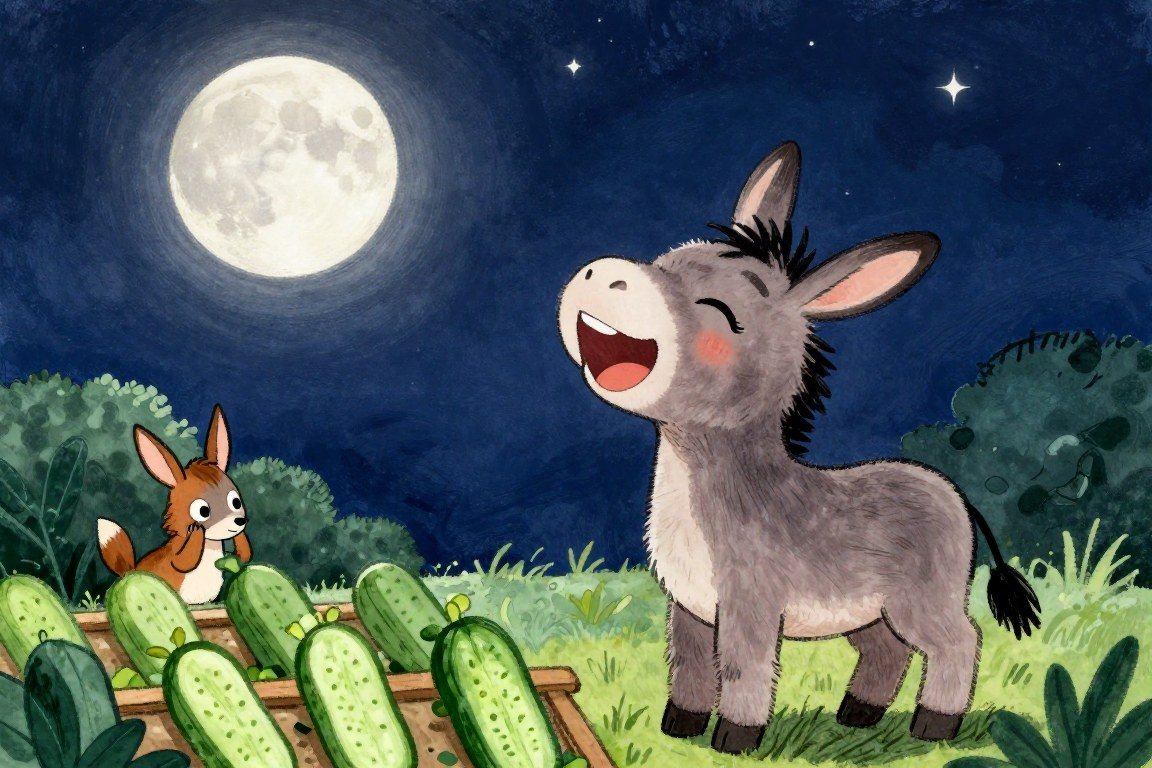
Uddhata closed his eyes, opened his mouth and began. It was a long song, and it went up and down like a rusty well-rope. It went across the field and over the hedge, and it was heard in the next village. Every dog in the district answered. The watchmen fell out of their cots.
"Thief!" they shouted. "Donkey! Cucumbers!" They came running with lanterns, and they banged their pots and waved their sticks. Uddhata, who had just reached the difficult part, opened his eyes and saw them coming. It came to him then that this audience was not going to clap.
He ran. He ran through the cucumber rows, through the bean poles and through the hedge, not by the gap but straight through the middle. No stick ever touched him. He galloped home in the moonlight with a long cucumber vine around his neck, and that was how the washerman found him in the morning, asleep on his feet, with leaves in his ears.
The farmer came along soon after, and he followed the trail of bean poles to the washerman's door. There was a long talk. At the end of it the washerman agreed that his donkey would pay for the eleven cucumbers, and for all the others too. So for one whole month, after his work at the river, Uddhata carried the farmer's baskets to the market.
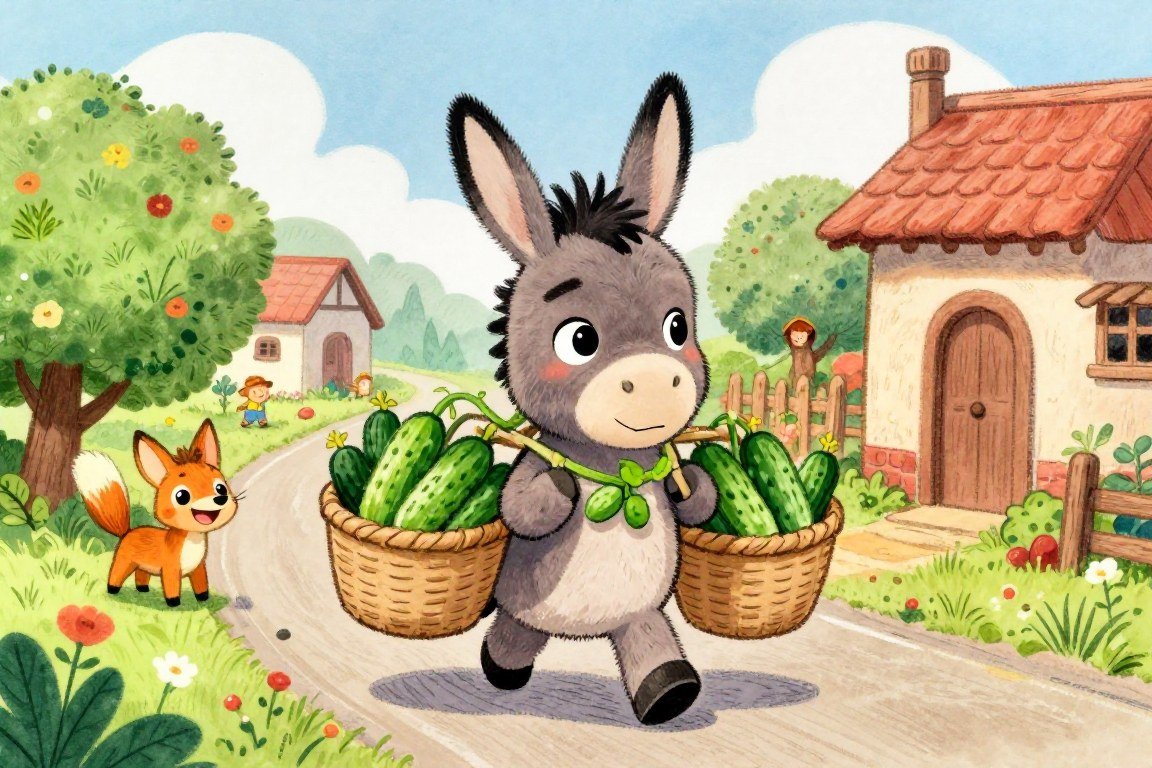
On the first evening of that month the jackal came out from behind a bush and walked along beside him. "Well, Uncle," he said. "How did the concert go?"
Uddhata walked on for a while with his baskets. "The audience," he said at last, "rose to its feet." And then, a little later, he said, "Nephew, perhaps you were right about the hour."
And so the old ones of that village still tell their children: "A good song at the wrong time is only noise. Before you open your mouth, look at where you are standing."
❦